

It fits only businesses that take cards; to start, phone (914) 554-1390 or use the request form.
Cash today in exchange for future card receipts: that is a merchant cash advance, and it is not a loan. This page covers how it is collected, what the factor rate and holdback mean, how to work out a factor rate from an offer, and three worked examples.
At a glance
- Snack and nonalcoholic beverage bars, Westchester County, NY
346 employer establishments (CBP 2023)
- Snack and nonalcoholic beverage bars at ZIP 10601 addresses
17 employer establishments (ZBP 2023)
- Accommodation and food services at ZIP 10601 addresses
135 employer establishments (ZBP 2023)
Revenue-based financing vs a merchant cash advance for White Plains, NY consulting firms
Revenue-based financing is a broad label for money collected as a share of a business's incoming revenue, which can be measured from bank deposits as a whole. A merchant cash advance is the card-sales form of the same idea: the provider buys a stated amount of future card receipts and takes its share from the card batches. Of the two, Cedarstone arranges the merchant cash advance.
That makes the card stream the deciding fact. Consulting firms and law firms that invoice clients and are paid by check or bank transfer have no daily card batches, so an advance has nothing to be collected from. A firm that takes retainers or fees by card does have that stream. In the 2023 ZIP file, 340 professional, scientific and technical services establishments had a ZIP 10601 address (ZBP); for a practice in that group, the answer turns on how its clients settle their bills.
A firm with uneven receipts but no card sales can look at a business line of credit instead.
How a merchant cash advance works for White Plains, NY law firms
- Card-processing and bank statements, several months of each, go to the provider first.
- It offers an advance amount, a factor rate and a holdback percentage; together they set the total to be collected.
- Once the firm accepts, the advance is paid out in one sum.
- Each business day, the holdback share of that day's card sales goes to the provider until the total is reached.
Because the daily amount is a percentage, a slow day sends less and a strong day sends more, but the total does not change. Some agreements instead take a fixed daily or weekly debit from the bank account; read which method the offer uses. A law firm taking card payments for fees should also check that client trust funds never pass through the account the provider collects from.
What a factor rate in an MCA means for White Plains, NY full-service restaurants
Think of the factor rate as a price multiplier; it is no interest rate. Advance times factor rate gives the sum the provider is entitled to collect. It does not grow with time: whether collection runs a short stretch of business days or a long one, the total stays where the contract put it.
| Item | Figure |
|---|---|
| Advance paid out | $24,000 |
| Factor rate | 1.30 |
| Total to be collected | $31,200 |
| Cost of the advance | $7,200 |
| Holdback on $1,850 of daily card sales | 10%, or $185.00 a day |
| Business days to collect the total at that pace | 169 |
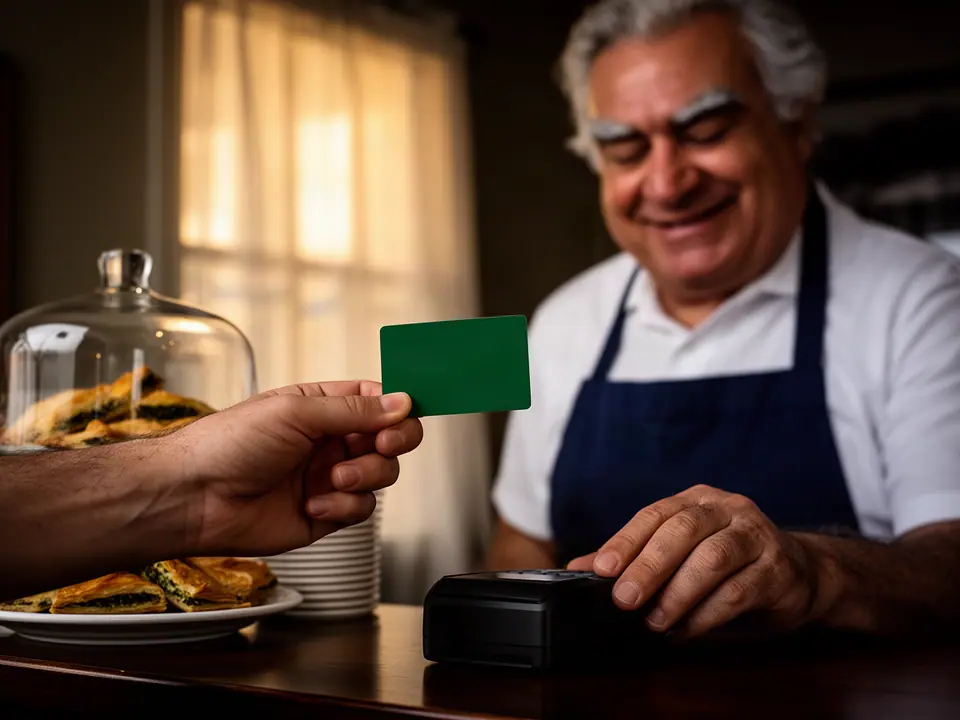
A cafe whose sales run through the card reader is a clear fit. Westchester County, NY counted 346 snack and nonalcoholic beverage bar establishments with paid staff in 2023 (CBP, NAICS 722515), the code that holds coffee shops. The ZIP-level file places 17 establishments under the same code at ZIP 10601 addresses (ZBP 2023).
How card sales collect a merchant cash advance at a White Plains, NY dental office
A dental office paid partly by card, for co-pays, uninsured treatment and payment plans, has a card stream an advance can be collected from. The insurance reimbursements that arrive by transfer are not part of it, so the holdback applies only to the card side of the office's revenue.
In plain terms, the provider has bought a slice of those future card receipts. It is not a loan: there is no interest rate and no fixed number of months, and the agreement sets out what happens if card sales fall or the office closes. That clause deserves a careful read ahead of any signature.
What a holdback rate means for White Plains, NY full-service restaurants with card sales
Each business day, a fixed slice of the card batch, the holdback, is set aside for the provider. It changes how long collection takes, not how much is collected.
| Holdback | Per business day | Business days to collect |
|---|---|---|
| 12% | $384.00 | 102 |
| 15% | $480.00 | 82 |
The higher holdback finishes in 20 fewer business days, but it takes $96.00 more out of every day's sales. A restaurant can ask which pace its own card days can carry.
Plug an offer into the calculator on this page, with its advance, factor rate and holdback plus the restaurant's average daily card sales, and it reports three things: total remitted, what the advance costs, and roughly how many business days remitting will take.
How Westchester County, NY dental offices calculate a factor rate
Divide the total the provider will collect by the cash the office receives. The result is the factor rate.
Illustration only, invented figures: an offer pays $15,000 and states $19,800 to be collected. $19,800 divided by $15,000 is 1.32, so the advance costs $4,800, or 32 cents on every dollar received.
Two offers are only comparable on the same advance amount. Write down the total to be collected, the holdback, any fees taken out of the payout, and whether collecting early lowers the total. Then ask how many business days the office's own card sales would need.
By Cedarstone Business Funding · Updated